



















Why is medtech website design harder than other health sites?
Medtech website design is harder because a medical device site is close to regulated communication, not just marketing. What you say about the device has to match what regulators have cleared or approved, in each market you sell in, and that status changes as you move from prototype to trial to launch. A sentence that's fine in one country can be a problem in another.
The second difficulty is the product itself. Software can be shown with a screenshot. A catheter, a wearable sensor or a surgical robot needs to be explained physically: how it's used, where it sits in a procedure and what the clinician sees. The third is the audience. A medical device website is read by surgeons, nurses, hospital value analysis committees, distributors, patients and investors, and each one is looking for something different.
If your product is mostly software or a care service, our digital health page is the better fit. This page is about health hardware and regulated devices.
How do you write device copy that stays within your regulatory status?
You write device copy by starting from your exact regulatory status and your indications for use, then making every claim on the site fit inside them. We ask for both before we write a word. In the US, a device that went through the 510(k) pathway is described as FDA cleared, while a device approved through premarket approval is FDA approved, and the two words aren't interchangeable. FDA also states that registering a facility or listing a device doesn't mean the device is approved.
Your stage | What the site can say | What to avoid |
|---|---|---|
Concept or prototype | The problem, the team and the approach | Any claim that the device is safe or effective |
In clinical study | That a study is underway, with neutral wording | Promoting an investigational device as safe or effective |
Cleared or approved in one market | Claims inside the cleared indications, with the market named | Implying the same status everywhere |
Cleared in several markets | Status per region, shown where it applies | One global claim that hides regional differences |
Our guide to health claims on your website lists the words that usually cause trouble, such as cure, guarantee and proven, and how to rewrite them.
Who reads a medical device website?
A medical device website is read by at least four groups, and most medtech startups only design for one. Clinicians decide whether the device fits their practice. Hospital buyers and value analysis committees decide whether it's worth the budget. Patients, where they're involved, want to know what it means for them. Investors and partners want to see the team, the regulatory path and the market.
Reader | What they look for | Where it lives |
|---|---|---|
Surgeon, physician or nurse | How it's used, workflow, training, clinical evidence | Product page, clinical evidence page |
Hospital buyer or value analysis committee | Cost case, reimbursement, integration, support, security | For hospitals page, document library |
Patient or caregiver | What it does, what to expect, who to ask | Patient page, FAQ |
Distributor or partner | Markets, regulatory status, ordering | Partners page, contact |
Investor or acquirer | Team, regulatory path, milestones you can share | About, investors, news |
In many markets, some content is meant only for healthcare professionals. Where your regulatory team says so, we design a clear "for healthcare professionals" section with a confirmation step, so patient-facing pages stay simple and the detailed clinical material sits where it belongs.
How do you show a medical device on a website?
You show a medical device by explaining how it works in use, not only how it looks on a white background. A beautiful product shot tells a clinician very little. What persuades them is seeing where the device goes, what they do with it and what changes in the procedure. We plan the visuals around that question.
- Annotated renders: a clean 3D render or photo with labels for the parts that matter clinically, built so the labels stay readable on mobile.
- Step-by-step use sequence: three to five frames that show setup, use and result, as illustrations or short loops.
- Context photography: the device in a real clinical setting, shot with consent, instead of stock images of smiling doctors.
- Interface screens: if the device has a display or a companion app, the real screens, with sensitive data removed.
- Spec tables: dimensions, compatibility and requirements in a table clinicians can scan.
Motion helps here, but it should explain, not decorate. Our guide to hero images versus video covers when a loop earns its weight, and every animation we build respects reduced-motion settings.
What should medtech branding look like?
Medtech branding should look precise and quietly confident, because clinicians and hospital buyers associate polish with engineering quality. The usual failure is generic clinical blue with a cross or a heartbeat line, which makes a novel device look like a commodity supplier. The other failure is consumer-style branding that feels too playful for an operating room.
We start with what the device changes for the clinician or patient and build the identity around that idea. In practice that means a type system with clear figures for specs and data, a color palette that stays separate from the clinical colors on your device or software interface, and a visual language that works on the website, the pitch deck, the packaging and trade show materials. Our article on healthcare branding goes deeper, and our brand identity service covers the full system.
What pages does a medtech startup website need?
A medtech startup website needs pages that answer each reader's question and a document library your team can keep current. We plan from this set and trim it to your stage.
- Homepage: the clinical problem, what the device does about it and its regulatory status, stated plainly.
- Product or technology: how it works, use sequence, specs and compatibility.
- Clinical evidence: published studies and ongoing trials, with links to the sources, managed in the CMS.
- For hospitals: the cost and workflow case, training, support and security answers for procurement.
- Document library: instructions for use, spec sheets and safety information, versioned and searchable.
- Company and investors: leadership, advisers, regulatory milestones and news.
Connected devices bring security questions from hospital IT teams, and since 2023 FDA has required cybersecurity information in premarket submissions for cyber devices. A short, plain security page answers procurement faster. Our guide to B2B trust pages covers how to structure one. If the site collects patient information through forms, read our guide to HIPAA-compliant website design before you launch.
What health-related work have we done?
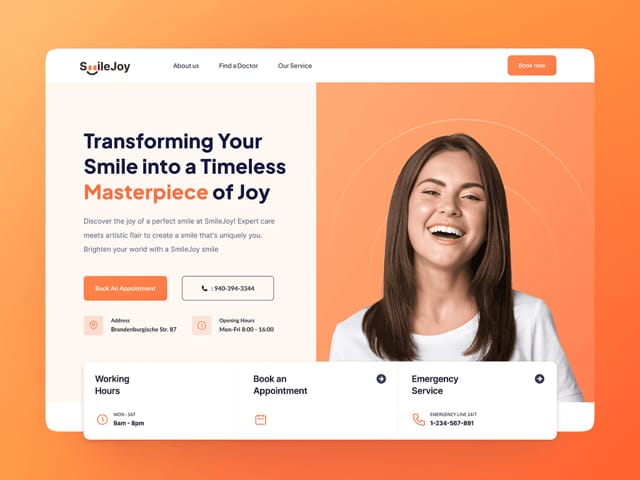
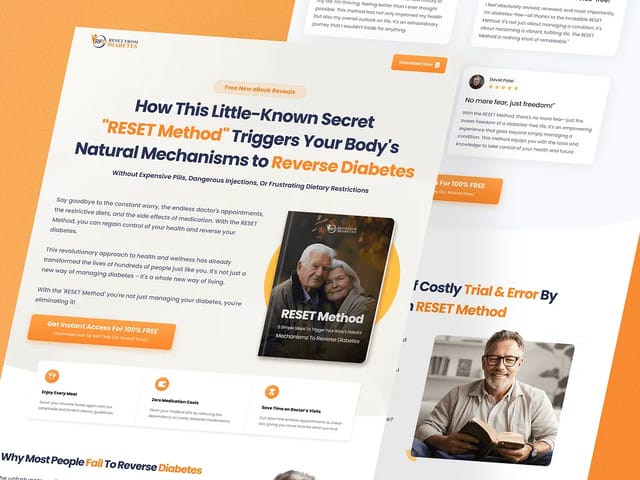
We designed the marketing landing page for SmileJoy, a dental service platform, where the job was making a personal, high-trust service feel modern and approachable. We also designed the funnel for Reset Method, a health book, which meant presenting a health topic clearly to a broad audience.
We haven't shipped a site for a cleared medical device yet, and we won't claim clinical or commercial results for any of our work. What we bring is a copy-first process that suits regulated claims, careful product visuals and an engineering team that builds fast, accessible sites your regulatory team can update.
How does our process work for a medtech startup?
Intro call
A free 30-minute call about the device, your regulatory status by market, your readers and your current site.
Claims and inputs
We collect your indications for use, approved wording and your regulatory team's guidance before writing.
Brand and design sprint
If the brand needs work, a $3,000 sprint: a brand refresh or redesign plus ten website explorations in Figma.
Copy, visuals and review
We write each reader's pages, plan the device visuals and mark every claim for regulatory review.
Build and launch
A Next.js site with a CMS and a document library, accessibility checks to WCAG 2.2 AA, SEO checks and a handover.
WCAG 2.2 level AA sets a minimum contrast ratio of 4.5:1 for normal text, and we design to it from the first exploration. Our guide to healthcare website accessibility explains why it matters for clinicians and patients alike.
What does medtech website design cost?
Our website package is $8,000 for up to six pages, fixed, then $500 per extra page, with copy, custom design, a Next.js build, a CMS and animation. Medtech branding starts with our $3,000 brand and design sprint, which is design only. Ongoing design and development, such as adding markets, trial updates or a companion app, runs on our $6,000 monthly retainer.
- Brand and design sprint
- $3,000
- Website, up to 6 pages
- $8,000
- Ongoing design and development
- $6,000/mo
Hypothetical example: a device startup between trial and clearance
For example, suppose a startup has built a wearable monitor and is running a clinical study ahead of a 510(k) submission. It needs to raise a round and recruit study sites, but it can't promote the device as safe or effective yet.
A sensible six-page site covers the clinical problem, the technology described neutrally, the study and how sites can take part, the team and advisers, news, and a contact page for investors and partners. Product and hospital pages are planned in the CMS and published after clearance, with copy your regulatory team has approved. This is an illustration, not a real client.
Timelines are scoped on the intro call, and medtech projects should allow time for regulatory review. The next step is a free 30-minute call; you can compare our offers on the pricing section.